If you asked anyone who’s spent a decade or more in an office what the lunchroom/cafeteria used to be like, you’re sure to hear a similar complaint: horrible fluorescent lighting, plastic trays, the hot food line that always ‘ran out’ by 12:15, and a room that everyone always wanted to get out of as fast as possible. It was a place you stopped at not to rest, but to eat.
That room has disappeared. Smart companies have either redesigned their lunchroom or have completely ‘deleted’ it.
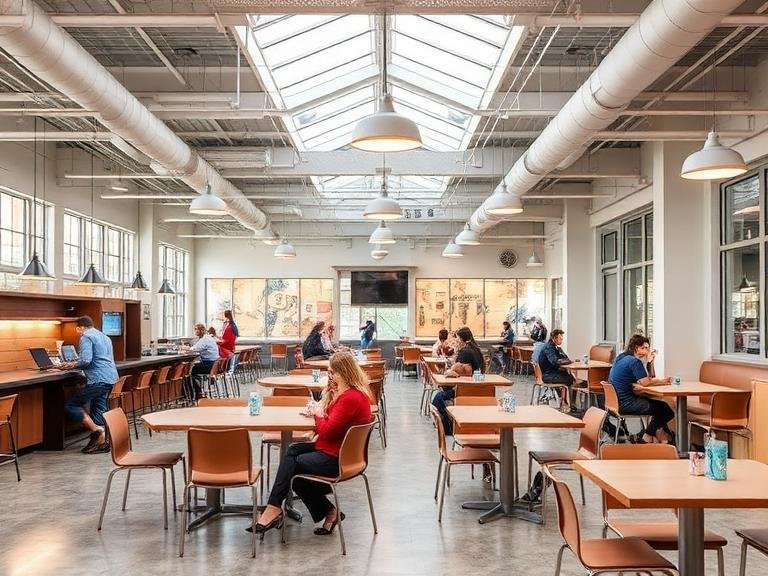
Now, if you walk into a cafeteria that has been redesigned, expect to see espresso bars, seating that’s designed to let you lounge in the space or work on your computer, hotel lobby seating, and phone booths either built or relocated into the space. This is an intentional design for a problem many workplace leaders have been facing: If people can work anywhere, why come to the office?
In many cases, the answer lies in the lunchroom.
The Cafeteria’s Quiet Career Change
The main role of a cafeteria was (and for many still is) to quickly serve a meal to employees to minimize time away from the desk. From an operator’s perspective, the success and failure of a lunchroom was largely dependent on efficiency.
This single-purpose thinking has been coming apart at the seams for a while, but hybrid work has accelerated this trend. When considering the value of a commute, employees are rarely considering the value of spreadsheets or standing desks. They are considering what the office provides that home doesn’t. One of the most effective answers to this consideration is a good cafeteria.
There is also an answer that is more practical. Workplace habit research has recognized that a large percentage of employees eat lunch in solitude at their desks. An office cafe that provides good-quality food and has employees present, diminishing loneliness, helps improve workplace culture and makes meetings unnecessary to solve this issue.
Employees have a cafeteria that fulfills the purpose of a restaurant, living room, informal meeting room, and even a decompression room. Designers refer to this as a “third place,” since in the absence of home and a workspace, it fulfills the role of a desk.
Why There Is More To This Beyond The Food
It is easy to think of an excellent workplace cafeteria as simply better catering. Of course, better food helps. But there is more to this than simply a better menu.
Now, it’s a collaborative area. The Cafeteria can now shift between being a space for individual lunches and a place for casual work gatherings. The Cafeteria is fully booked from 1 pm until closing and is used as a meeting space when all the other booked spaces are full.
Now, it’s a wellbeing indicator. Businesses that are serious about the wellbeing of their employees consider the quality of the food provided at work, and gone are the days when this was an afterthought. That focus and investment to provide better and healthier food options is an indicator of the care and wellbeing of the employees, something that a “We care about you” poster in the break room does not.
Now, it’s a celebration of company culture. Some of the workplace cafeterias that have become the most popular and have even crossed over into brand experiences are a good example of this. For example, a company that is a beverage company built a bar-style space that serves their products. Having a cafeteria provides a space to showcase a company’s culture and values that a lot of other spaces lack.
Now, it’s a recruitment resource. In the hybrid work world, employees have more options, and the office has to compete with other food options like the cafeteria in their own home. Having a cafeteria that is desirable to walk to adds to the incentive to come to the office.
Forms of Cafeterias in the Present Day
There are various forms of Cafeteria layouts. Some are better suited for some organizations versus others. While some layouts feature more flexibility, some rely on a more fixed framework.
- Completely flexible Casual layout: Cafeterias with this layout feature a mobile framework. While sofas still anchor the layout, the furniture is lightweight and can easily be rearranged. This layout can serve as a makeshift training room that can be rearranged to serve as a lunch spot later on.
- Fixed Casual layout: A layout with this style incorporates a framework that’s comfortable and resembles a café. The pieces in this layout are of varying heights to make seating choices quick and easy.
- Mobile Formal layout: This style consists of a polished framework that’s more formal and can easily be rearranged to accommodate various purposes.
- Fixed Formal layout: This style consists of a framework that’s more formal and reminiscent of a conference room. While this layout can also serve as a conference room, it’s flexible enough to accommodate a meeting.
Choosing one layout over another is more a matter of needs. While some layouts can serve more people at a time, some are designed to serve more people overall across various purposes. Lastly, some layouts are designed to accommodate various purposes more than others.
Real World Examples
Look no further than the notable HR software company that put a well-being center and café in a two-million-dollar, two-story building. Employees can finish their workout and grab a cold brew and snacks with no hassle. The global beverage company put a café on the top floor of their New York City office, and had social hours on Thursdays. If you can avoid the grind of meetings and have a little fun with the crew, it’s a win in their book. The regional bank’s commitment to community and sustainability is literally central to the architectural design of their new headquarters. Their community-centered café is the focal point in the center of the bank’s new headquarters.
Unlike their competitors, these companies have the intent to be engaged with their employees’ well-being and workplace satisfaction. These companies designed their cafés with the same level of intention as the design for their meeting rooms and lobby.
How to Improve Your Workplace Cafeteria
If a full redesign of the cafeteria is not an option, then these ideas can be implemented in an existing space.
Add a variety of seating. Some employees want to grab a quick bite and go, while some may want to take their lunch to the office and eat there. Flexible seating with high tops, lounge seating, and regular tables may be just what your employees need.
Use windows to let in natural light. Where possible, bring in plants. Biophilia improves the appearance of a space while calming it and making the space more welcoming. It gives the impression of greater expense than it actually is.
Consider your menu as a mechanism for culture building, as opposed to box ticking. The values of an organization are better represented by the choices of freshly prepared, locally sourced, and rotating options. than an internal memo.
Consider your cafeteria as a workspace, and introduce technology appropriately. Outlets, good Wi-Fi, and a couple of screens are the difference between a decent cafeteria and a workspace.
Don’t restrict a cafeteria to an hour between 12 and 1. Extended hours with coffee and a few snacks make it easier to use the space for purposes beyond lunch.
The Bottom Line
The workplace cafeteria has become one of the most desirable features of modern offices. The improvements in menu offerings are secondary to the first impression that the modern office is able to provide: a welcome break from the monotony of a long day of work, a facility for lunch, and an opportunity to socialize with coworkers away from your workspace.
Get the design right, and it stops being a place people pass through. It becomes the place people remember.